Above (left to right): Andrew Robinson as Longaville, Mika Shara as Berowne, Sanjay Talwar as King Ferdinand of Navarre & Thomas Olajide as Dumaine
Above (left to right): Sarah Afful as Rosaline, Tiffany Claire Martin as Katherine, Ruby Joy as The Princess of France, Ijeoma Emesowum as Maria and their servants
Friends Berowne, Ferdinand, Dumaine and Longaville have all sworn an oath to abstain from the company of women and devote themselves to their studies for the next three years. Everyone accepts this arrangement, though Berowne is hesitant from the beginning if they will be able to do it. Soon after their oath is taken four women, led by the Princess of France, arrive to speak with King Ferdinand who reluctantly agrees to meet with them. Ferdinand instantly falls in love with the Princess, as his fellow scholars quickly fall for her ladies. They've sworn off women, but with the presence of these fine ladies, will they be able to ultimately fulfill the oath they've sworn to each other?
Love's Labor Lost is a Shakespeare play that I honestly know very little about. When it comes to me and Shakespeare I've usually read the play or at least know the significant quotes from it, but this was not the case with Love's Labor Lost. The only thing I knew was that some consider Love's Labor Lost to be the prequel to Shakespeare's Much Ado About Nothing (also known as Love's Labor Won), so I went into this production completely open and raw. Because of this, I think I was able to enjoy and understand more about the play then what I could read in a book. The cast was strong overall, though two performances particularly stood out. The first was Mike Shara as Berowne, whose playfulness and great ease at comedy made him flourish from beginning to end. Shara also had one, if not the best, monologue on the entire show and his delivery of it left my breathless and slightly teary. Having seen Shara is various Stratford productions, I strongly believe him to be an actor perfectly fit for Shakespearean comedies. The other performance that somewhat surprised but delighted me was that of Gabriel Long as Moth. Remembering him from last years production and personal favorite A Midsummer Nights Dream, I thought Long would mainly be on stage along for the ride with not much in the way of lines. I was very wrong, as Long had a substantial amount of text and was on stage with other actors for a majority of the play. Longs performance is a wonderful reminder that anyone can do Shakespeare no matter their age.
This production used traditional settings as well as costumes from the time period. For a play such as Love's Labor Lost I believe it would be difficult to set the play in a new setting without detracting from the text and the message the play ultimately leaves us with. This said, I loved seeing the cast in authentic costumes and looking down on each other from various balconies and staircases. But perhaps the greatest question of the play is what is the message? While much of it can be left up to interpretation, I believe the message can be summed up in one line from Berowne's significant monologue in Act IV: "Let us once lose our oaths to find ourselves, or else we lose ourselves to keep our oaths."(Berowne)
Keeping our promises is important, but to lose ourselves in the process is something far worse than breaking those promises.
Love's Labor Lost was a very refreshing production within Stratfords 2015 season. A play about the power of words, Love's Labor Lost is a production not to be missed this summer at the Stratford Shakespeare Festival.
Stratford Shakespeare Festivals Love's Labor Lost Trailer
For photos and videos of this production, visit:
http://www.stratfordfestival.ca/WhatsOn/PlaysAndEvents/Production/Loves-Labours-Lost and click on Videos & Photos
For more information about The Stratford Shakespeare Festival, visit:
It never stops (even when summer is over and school has once again begun).
UPDATES:
(Updates on finished anime series)
1. Blue Exorcist (Ao no exorcist) (2011)
Video: Blue Exorcist Opening
Blue Exorcist follows brothers Rin and Yukkio Okumara who both strive to one day become exorcists like their father. Younger brother Yuukio studies hard to make this dream a reality while older brother Rin finds himself in trouble more often than not. But everything changes when Rin learns a terrifying and dark secret: he is the son of Satan. After learning that he is a demon, Rin's father is killed and he vows to avenge his father's death by becoming an exorcist and one day defeating Satan once and for all. Learning that his brother Yukkio is already an exorcist of high ranking at a private academy, Rin is taken in immediately to begin his exorcist training under his brothers strict watch. Becoming an exorcist is the ultimate dream, but in the process, will Rin lose everything he has left?
Why I began this series: The idea of a demon wanting to destroy his father Satan seemed like an amazing concept, and I finally finished this series while waiting out my six hour layover in the Frankfurt, Germany airport on the way to Graz!
What I loved about the series: Much of the series I enjoyed. Many of the characters were memorable, the original concept intrigued me beyond belief and I can't pass up any anime that stars two of my three favorite anime voice actors, Bryce Pappenbrook and Johnny Young Bosh.
What I didn't like about the series: Sadly, much of the series was filler and boring. It started strong with Rin learning the truth and beginning his training at the academy, but much of the series that followed made the story take a backseat. It wasn't until the last few episodes that the original excitement I got from Blue Exorcist, and when that excitement was back I was thrilled. Some of the characters seemed dull and some plot points didn't really add anything to the overall arc of the series.
Blue Excorcist seems to be either a "love it or hate it" anime. While I did enjoy it, the series didn't really do anything for me and therefore isn't high on my recommending anime list. Nevertheless, Blue Exorcists is a good anime for any fan.
Misunderstood high school student Ryuji Takasu has always been labeled as a delinquent due to his tough appearance, while in actuality he is a soft-hearted clean freak. When Ryuji one day accidentally bumps into fellow classmate Taiga Aisaka, known for her small size, violent temper and harsh attitude, his life takes a turn. Upon discovering a love letter in his schoolbag addressed to his best friend Yusaku from Taiga, he suddenly sees Taiga coming through his window with a sword. Tiaga soon realizes that the envelope containing the letter was empty all along, and reluctantly tells Ryuji of her feelings for Yusaku. While Ryuji can't believe that Taiga could be in love with anyone, Taiga calls him out on his obvious feelings towards her best friend Minori. Ryuji and Taiga then make a deal to help each other become closer to their respective love interests and do whatever is necessary to find out how they feel about in return, but in the process will something more than friendship bloom between them?
Why I began this series: Between looking for something to fill the void after Clannad & Clannad: After Story and researching various romance animes, I came across Toradora.
What I loved about the series: Toradora is a great anime all the way around. The voice cast for the English dub is perfect and all the voices really fit the characters animation. I especially loved Toradora because of how simple and somewhat innocent the story line is. High school, teenage love can be very hard to do right, sometimes being overdone to the point of annoying or really, really boring. Toradora shows EXACTLY what being in love at a young age is all about.
What I didn't like about the series: The only thing about Toradora that stuck out was one character: Ami Kawashima. She doesn't appear to have any real purpose in the series, other than causing, escalating or creating drama.
While many people may not know Toradora, it is an anime that I would highly recommend to anyone. A very down to earth, honest romance anime about being in love.
3. AngelBeats (2010)
Video: AngelBeats Opening
What happens when you die? For Yuzuro Otonashi it all begins as a jumbled mess of confusion. Having recently passed away, Yuzuro awakens to find himself in a strange place and does not remember anything about what happened to him or who he is. Soon after, he learns that he is in fact dead and now a member of the SSS, a squad dedicated to fighting and destroying a mysterious girl named Angel. But Otonashi has another purpose: making peace and moving on. Once he is able to do this, he will be reborn into the world as another creature. Angel is the enemy, but will fighting and defeating her be the right path to ultimate peace?
Why I began this series: I watched AngelBeats purely because of the fan following it has. It looked interesting from the start so I gave it a try.
What I loved about the series: A few things about AngelBeats particularly stood out in a good way for me. The first was the series opening and ending themes: stunning. Second was the fact that the English dubbed cast was basically the entire cast that dubbed another favorite anime of mine, Clannad and Clannad: After Story. Third was the cast of secondary characters, who were far superior to the three leads in development, entertainment and emotional connection. The secondary characters were not only my favorites of the entire series but also had some of the best and most emotional, beautiful scenes.
What I didn't like about the series: Much of this series didn't speak to me. Sadly, I was expecting something better than what I got. Some tears were shed though, make no mistake.
If there was one thing to say about AngelBeats, it's that the series was completely not what I expected, and that's what makes it so unique.
4. Ouran High School Host Club (2006)
Video: Ouran High School Host Club Opening
Haruhi Fujioka has just been accepted into Ouran High School Academy, an elite institution for educating children from filthy rich families. Though a commoner, Haruhi enters Ouran hoping to make a fresh start until she accidentally finds Ourans Host Club. Infamous to entertaining Ouran young ladies, Haruhi attempts to escape the club but accidentally breaks an expensive vase belonging to the club. To pay off her debt, Haruhi is forced to become a member of the Host Club under the eye of the Host Club King, Tamaki Suoh. Haruhi accepts this arrangement until Tamaki discovers that though her appearance is manly, Haruhi is actually a girl. Despite this fact, Harihu agrees to dress and act like a boy in order to pay back the club, which Tamaki reluctantly allows. Until her debt is paid, Haruhi must entertain the ladies of Ouran who "have to much time on their hands" while hiding the secret of her true gender.
"The Ouran High School Host Club will be waiting for you. We'll see you then!"
Why I began the series: I was surfing Netflix when I originally found Ouran, and I got halfway through episode one before I turned it off. I recently decided to give it another chance, and now, I've seen it all.
What I loved about the series: This series really surprised me. At the start I was expecting to absolutely hate it, but that ended up not being the case - I loved it. Though it does center around "entertaining" young ladies, the series did not retract to the the usual Japaneses harem stereotypes and I was not consistently flashed with boobs or panty shots (which I greatly appreciated). But perhaps the best part of the Host Club are the Hosts themselves. A quick breakdown:
Tamaki Suoh - "The Prince Charming type" aka King of the Host Club; most requested of all Hosts
Kyouya Ootari - "The Cool type"; Vice President, in charge of Host activities and funds
Mitskuni "Honey" Haninozuka - "The Cute type"; loves cute things and cake
Takashi "Mori" Morinozuka - "Strong & Silent type"; cannot be seen without Honey-sempi
Karou & Hikaru Hitachiin - "Brotherly Love type"; twins who have never been apart
(Haruhi Fujioka - "The Natural type")
What I didn't like about the series: I loved everything about the series, overall very well done.
Ouran has become one of my favorites. Long live The Host Club!!!
5. Seraph of the End (Owari no Seraph) (2014)
Video: Seraph of the End Opening
A mysterious virus one day kills everyone over the age of thirteen and a swarm of vampires descend on the world. Granted safety in exchange for their blood, the surviving children become livestock for the vampires who now rule the Earth. Yu and Mika both dream of escaping from the vampires and venturing to the outside world, even though they may die from the virus upon reaching it, and one day that dream becomes reality. Yu, Mika and their family attempt to escape but are met by a Noble Vampire who kills the entire family and Mika while Yu escapes to the outside. Having just set foot in the outside world, Yu meets Commander Guren, a man in charge of various squads dedicated to eliminating the vampires and reclaiming the world for the humans. Yu pleads to train under him and kill all the vampires who have destroyed his life and Guren accepts. Yu vows to destroy all vampires, but due to unforeseen circumstances, will that vow come back to bite him?
Why I began the series: I once again went searching for animes, this time looking for something more recent. I found Seraph of the End, which was currently still airing episodes weekly with the English dub, and I dove in.
What I loved about the series:
Initial thought after finishing Episode 1: "FINALLY, AN ANIME ABOUT VAMPIRES THAT IS OVERLY DRAMATIC, OVERLY SEXUAL OR JUST PLAIN STUPID". But really though,
Seraph of the End: Vampire Reign turned out to be way better than I expected. The characters are memorable and the animation (done by FUNimation) is beautiful. Also, Mika is pretty amazing.
What I didn't like about the series: The only thing that kept Seraph of the End: Vampire Reign from being absolutely amazing was the fact that it often had plot holes. While I'm sure everything is explained within the manga (which I am currently reading now), the series at times had me very confused as to how certain things happened, why and what impact they had on the current or future situation. Hopefully by reading the manga, things will get cleared up. The other thing about the series that I particularly did not enjoy was some the voices selected for the dub, which for me is unusual.
Season 1 of Seraph of the End: Vampire Reign was far better than I would have thought, and now I anxiously await for the Season 2 Dub being released in October.
6. Spice & Wolf (2008)
Videos: Spice & Wolf Opening 1 & 2
Craft Lawrence has always been a traveling merchant weighing his gains and loses with the utmost care, for both his business and everyday life. When Lawrence one night discovers a naked woman with a wolfs ears and tail sleeping in his cart, he suddenly remembers legends pertaining to such a creature, known as Holo the Wise Wolf. After proving that she is indeed the Goddess Holo the Wise Wolf, Holo tells Lawrence that she desires nothing more than to return home to the lands of the north. Lawrence reluctantly agrees to accompany Holo while upholding his business as a traveling merchant, but as the two travel, what secrets will Holo and Lawrence learn about themselves and the nature of business?
Why I began the series: I honestly don't know how I cam to find Spice & Wolf. I'm sure it had something to do with the fact that I was, and am still on, a J. Michael Tatum binge.
What I loved about the series: My enjoyment of the entire series came from its two leading voice actors: J. Michael Tatum as Lawrence & Brina Palecia as Holo. The two not only do various and fabulous anime voice work together, but also provide the voices for another favorite anime of mine, Black Butler (voices of Ciel Phantomhive & Sebastian Michaelis). The animation for Spice & Wolf is also stunning, as can be seen in both its opening themes.
What I didn't like about the series: The series focused more on the "economics" side than the romance I was initially expecting, but although this was the case, it did not detract from the flow of the series. The other thing I didn't like about the series was its ending, as it somehow felt unfinished.
Spice & Wolf was another series that I found quite unexpected and very cute. It also has a decent fan following and many hope that there will someday be a Season 2. If that day ever comes, I'm sure to be watching.
SERIES STILL IN PROGRESS:
(Because this list is somewhat longer than usual, I will not be including any images, videos or information about where I am in each series)
Sword Art Online - Season 2 (Almost done airing with English dub) (2015)
Gurren Lagann (2007)
Kimi ni Todoke (English subbed) (2009-2011)
Sakurasou No Pet Nakanono (English subbed) (2012-2013)
Hyouka (English subbed) (2012)
Charlotte (English subbed) (2015)
(The Devil is A Part Timer) (2013)
The list continues to grow, and although school has resumed, I look forward to watching and reviewing more and more anime!
Can we escape our fate, or are we forever destined to travel the path it has chosen for us?
The city of Thebes is in turmoil. Oedipus, the King of Thebes, promises to help his citizens however he can but when brother-in-law Creon tells him that Thebes is in such a state due to the mysterious murder of the former King Laius, Oedipus vows to find, capture and kill the murderer to avenge the Gods and end the plague within Thebes. Oedipus will do whatever it takes to uncover the truth, and summons the prophet Teiresias for help in the matter. When Teiresias tells Oedipus to abandon his search and that Oedipus himself is the killer, Oedipus becomes enraged and vows to continue his search but to find the culprit, what will Oedipus discover about himself and his ultimate fate?
I've read Oedipus Rex for various English and Mythology classes, so I was thrilled to see Sophocles' masterpiece on stage for the first time and I was in no way disappointed. Led by Gord Rand as the fated King Oedipus, this Stratford Shakespeare Festival's production was easily my favorite of the season due to its intriguing subject matter with modern twists and the intense deliveries given by the entire cast from beginning to end.
Oedipus is a tricky character, thus he requires an actor who is willing to take any and every risk. Gord Rand was perfect to play the fated king as he was willing to do this and more. Rands commitment was far beyond what I ever would have expected, and because of this, his entire performance was utterly mesmerizing. From giving monologues atop tables to ending the play on stage butt naked for a solid amount of time, Rands Oedipus is nothing short of magnificent. Alongside and equally as important and wonderful was Yanna McIntosh as Oedipus' wife and voice of reason, Jocasta. Though Jocasta does not have much in the play, McIntoshs performance was quite powerful and played off of Rands wonderfully. I have always believed that actors are either good at comedy or tragedy and on rare occasion I'll find one that can do both, suffice to say after seeing McIntosh in various Stratford productions she flourishes in tragedy. But perhaps my favorite performance of the night was given by Nigel Bennett as the blind prophet Teiresias. On stage for no more than ten minutes in the role, Bennett had me in the palm of his hand from the moment he entered the stage. His lines were incredibly powerful and the way he simply would sit silently in his chair was extraordinary. This trio along with perhaps the strongest ensemble cast I have ever seen isenoughreason alone to see this revolutionary production of Oedipus Rex.
The plays modern setting and minimalist set also added to the dark undertones of the tragedy. Upon first entering the theater and seeing the set, the first thing that came to mind was something like a concentration camp: tall posts with fog horns, one table and rolling chair and a set of collapsible chairs all around the stage. The only other piece used for the production was a microphone where the chorus took turns giving speeches to the masses of Thebes. Setting this production in modern times was extremely smart and gave new life to the famous Sophocles work. Similar to its set all costumes, with the exception of Jocasta and the prophet Tiresias, were either black, dark or light gray, showing a majority of the plays symbolism along with its gloomy outlook.
Everything about this production was simply incredible. It is truly a hidden gem among Stratfords 2015 season.
"How dreadful the knowledge of the truth can be, when there's no help in truth."
Stratford Shakespeare Festivals Oedipus Rex Trailer
For photos and videos of this production, visit:
http://www.stratfordfestival.ca/WhatsOn/PlaysAndEvents/Production/Oedipus-Rex and click on Videos & Photos
For more information about the Stratford Shakespeare Festival, visit:
Ever heard of Pericles? Most probably haven't. Despite its obscurity, Stratford's 2015 production of Shakespeare's The Adventures of Pericles brings this unknown masterpiece to light as an adventure centered around love, loss and family.
Pericles, Prince of Tyre has arrived in a distant land seeking the hand of a young maiden. Before he can win her, her father the King presents him with a riddle which he either must solve or pay the cost with his life. Pericles accepts the challenge and is appalled when he unearths the King's secret incest with his own daughter. Discovering that the King will go to any length to keep his secrets hidden, Pericles flees and sets sail for home but soon after a storm comes and carries him away to other lands. Now alone and lost in the world, Pericles must find his way home while battling constant storms upon the sea and in his own heart.
After learning that festival superstar and personal favorite of mine Evan Builing would lead the charge of this production as the daring and kindhearted Pericles, I became instantly excited. I had heard of the play before but knew nothing about it and was incredibly interested in how the play would be presented. Builing's commanding presence and moving performance as Prince Pericles was wonderful, inviting the audience into a whole new world. Trying to compare Builing's performance this season with his incredible performance last season as Edgar in King Lear along with other Shakespearean rolesis simply impossible, showing Builing's incredible versatility and love of Shakespeare. Builing's portrayal of Pericles is a performance not to be missed and he consonantly proves a force to be reckoned with both in and outside Shakespeare. Alongside Builing was Deborah Hay, playing double roles as Pericles' wife and daughter. I was at first hesitant of her playing both roles but I found that having Hay portray both was a very smart idea, and because of this the ending scene with Hay and Builing was especially beautiful and moving. These two alongside a wonderful ensemble of characters made The Adventure of Pericles a joy to watch.
Other aspects of this production were incredibly (something) but greatly enhanced the storytelling needed to pull off the production. No big sets were really used but instead only small pieces and visual effects to show the change over time or a storm at sea. Director and Stratford actor Scott Wentworth took these and many other risks in the staging of The Adventures of Pericles and every single one paid off. Elaborate scenes and flashy costumes do not always make the play, but instead it is the actors themselves, the characters they portray and their overall connection to the audience as storytellers.
Pericles has everything - adventure, drama, joy, agony, loss, love and the list goes on. Though not one of William Shakespeares more prominent works, The Adventures of Pericles proves itself to be a story about life and how those in our life can make all the difference.
Stratford Shakespeare Festival's The Adventures of Pericles Trailer
Before I begin my final review, I would like to thank everyone who has kept up, read or even clicked on these reviews! I'm sure over the course of the next few months this black hole with grow deeper and I hope to continue reviewing as much as possible.
FINAL REVIEW!
Fallen Angel
Above & Below: The Aiba Brothers - Tsubasa (Kazuki), Riku (Takuya) and Umi (Takumi)
As with Sign, I will not be presenting a full synopsis of Fallen Angel as it is a highly complicated plot to try and explain. If you are interesting from the short synopsis below, check out the series itself which will be linked at the end of this review!
Synopsis:
Umi Aiba has always been different. Sent away by his mother, Umi only knows one thing: he must find his older brothers Riku and Tsubasa. When Tsubasa, a mathematical genius and Riku, a University student suddenly find Umi at their door claiming to be their younger brother everything about their lives change. Claiming to be sent away from a field hospital by their mother, a well known surgeon, and was told to find his older brothers who are to look after and protect him. Weary of his story but wanting to help, Tsubasa and Riku agree to take Umi in but as time goes by, mysterious family secrets are uncovered, dark truths come to light and the ties of brotherhood and family may forever be broken.
REVIEW
The Cast:
Umi Aiba - Kitamura Takumi
Riku Aiba - Uehara Takuya
Tsubasa Aiba - Kato Kazuki
Kuma - Chiba Yudai
Hikaru Kitahara - Sasaki Yoshihide
Kondo - Nakagauchi Masataka
So Kiryuu - Baba Toru
Casting & Individual Performances:
Another small cast like Sign, Fallen Angel's cast was very well chosen and presented in the nine episode drama. Though not as important to the plot as one might think the main protagonist, Umi played by Kitamura Takumi, was very well done. Kitamura's innocence and portrayal of the conflicted and confused Umi held my attention from the start and his character took the series in a variety of directions I was not mentally or emotionally prepared for. Alongside Kitamura, Uehara Takuya as Riku and Kato Kazuki as Tsubasa made great companions and foils to Umi. It should come as no surprise that Takuya was once again fabulous, this time as a somewhat bad boy and smart mouth. Seeing Takuya play a character so unlike those he has played before was very refreshing and his overall performance as the laid back brother immensely lightened up the series from its continuous dark, dramatic and intense tones. Kato Kazuki as Tsubasa also proved a powerful performance for a variety of reasons I can't go into due to possible spoilers. Perhaps the true star of Fallen Angel is Chiba Yudai's performance as the series villain, Kuma. From the first moment he came on screen Yudai proved himself a force to be reckoned with as a great villain with a purpose. I often find myself more interested in the villains more than the leads because of their motives and purposes for their actions, and without giving too much away, Yudai gave great life and reason to the character known as Kuma. The final performance that stood out was that of Hikaru Kitahara as Sasaki Yoshihide. An "interesting" character to say the least, Kitahara's character choices made great impacts on the series despite his small amount of screen time. From its leads to supporting characters the entire cast of Fallen Angel was very powerful and left a lasting impression on me once I had finished the series.
Other Thoughts:
This series evoked more roller coaster emotions out of me than I ever would have expected. At various times I found myself screaming at the screen (as all those who fall deep into a TV series will understand) and there were many times I couldn't contain my tears. The end of the series was most shocking to me, and though it ended sadder then I would have liked or expected, I'm not sure how else it would have ended had it not done so in the way it did. If you're looking for an intense, emotional series - this is it.
Final Thoughts:
Interested in learning more about Fallen Angel? GO WATCH IT! I highly recommend it.
The entire series of Fallen Angel can be found on YouTube at:
Why is the world dived into two different parts: this is ultimate question of Black & White
Synopsis:
In an unknown time, angels and demons were created to balance the world. Created in the same image and labeled with a five digit code number, angels of white strive to bring peace to the world while demons of black seek to bring havoc and destruction. This is how it always has been, until one day something strange happens - Kuro, and angel of black and Shiro, a demon of white are born and both labeled 18782.
Above: Kuro (Takuya) in The realm of the Angels
Above: Shiro (Dori) in The realm of the Demons
The angels seek to spread messages of peace and live pure "white" lives. Though a black Kuro tries his hardest to be like his fellow white angels, but the angels ignore Kuro and cast him aside. Opposite the angels, demons seek to cause trouble and make the world a "blacker" place. Like Kuro, the white demon Shiro tries to be as cold hearted as his fellow demons but cannot stand his ground. When during daily training Shiro refuses to kill and collect the souls from captured humans, the demons shame him and refer to him as "unwanted guy" (an alternate Japanese pronunciation of his label 18782). Feeling alone and about to follow the others, Shiro comes across an abandoned videotape lying on the ground. Nervous but curious, Shiro decides to play the tape and is shocked to discover that it is a "How To Make Friends" video with various episodes on how to make and keep friends. Having never heard of or had a friend before, Shiro becomes enveloped in the concept of friends and decides to run away from the realm of the demons to find himself one of these "friends".
Above: The Treasure Hunter studies the blue-red jewel known as the Blue Garnett
Kuro sits alone in the realm of the angels until a strange man suddenly appears to him. After explaining that he is an angel, the man tells Kuro that he is a treasure hunter and been searching for the five blue-red jewels known as the Blue Garnetts and that once all five are collected the jewels grant the collector one wish. The treasure hunter appeals to Kuro to find the four remaining jewels in his place and wish to revive him and in exchange, he will tell Kuro how to become a white angel. Kuro agrees and sets off to find the Blue Garnetts until he is suddenly interrupted by a swarm of angels who attempt to capture him, while at the same time Shiro is being perused by the demons. Having lost their respective parties, Kuro and Shiro accidentally bump into each other and Shiro quickly explains that although he is white he is actually a demon and known as "unwanted guy". Kuro tries to leave but is stopped by Shiro who suddenly asks to become friends. Kuro shows no interest and angrily leaves to find the remaining four jewels with Shiro close behind singing what he calls "the friend song".
Kuro and Shiro travel to the first world where the next Blue Garnett is hiden, The World of Contradiction. The holders of the jewel, the Okama roses, appear and explain how they abide by the laws of contradiction and use dance to explain themselves. With Shiro close behind, Kuro arrives in the world and quickly orders the roses to hand over the jewel. They agree to do this, but only if Kuro and Shiro are able to move them through dance. The roses then give both Kuro and Shiro various, strange themes to which they must dance to in order to obtain the jewels. Kuro and Shiro endure the roses demands until they are satisfied and willingly hand over the jewel. With three jewels left to collect Kuro and Shiro head to the next world.
Above: Kuro (Takuya) and Shiro (Dori) on their journey to find the Blue Garnetts
The next Blue Garnett resides in The World of Repulsion. Kuro and Shiro arrive in this world to find themselves surrounded by magnets and stuck together unable to separate. The pair quickly learn that they can be seperated and put back together by a throw of the switchbox and explain that they are collecting the Blue Garnett jewels. Having never heard of the Blue Garnett, the magnets state that such a jewel does not exist but adamant it must be there Kuro persists. He is finally granted permission to search for the jewel if he is able to defy the laws of repulsion and separate the magnet poles. After learning that certain rhythms are what can do this, Kuro and Shiro begin dancing and successfully separate the magnets. Kuro desperately searches for the jewel and comes to the switch box, which he destroys to find the Blue Garnett inside. As the two prepare to leave the world of magnets and continue their search, Shiro nags Kuro once more about becoming friends and begins singing the "Friend Song" from the video. Kuro becomes angry, casts Shiro aside and continues to the next world. Shiro takes this opportunity to watch more of his video and learn of other ways to make and keep friends before running after Kuro.
Kuro and Shiro arrive in the third world after hiding from their respective groups who are relentlessly searching for them. Having arrived in third world, The World of Language, the two meet a being who agrees to give over the Blue Garnett if they can impress him with backwards language. Kuro refuses to take part and attempts to steal the jewel but is ultimately unsuccessful. Wanting to help his friend, Shiro steps in and holds an elaborate conversation of backwards language with the being until he hands over the jewel. Shiro runs to Kuro and hands over the jewel stating that he would do anything for a friend. Kuro takes it and the two continue to the next world.
With only one jewel left to collect, Shiro becomes excited that the friendship he has with Kuro will become stronger once they have completed their task. He starts the video and breaks into the "friend song" which irritates Kuro to such an extant that he rips the tape out of the player and destroys it. Horrified, Shiro calls Kuro a demon and frantically tries to fix the tape and attempts to watch once more, though it no longer runs properly. Shiro watches what is left of the video, reminisces about his life as a demon and the number he has been cursed with before following Shiro to the final world.
Kuro arrives alone in the next world and finds himself among a group of mushrooms playing games. Kuro joins in and cheats hoping to obtain the final jewel quickly and without much embarrassment. Just when he thinks he has won, the mushrooms suddenly disappear and Kuro finds his hands bound and surrounded by angels. Realizing that he has been tricked, Kuro is left guarded for the night and all is quiet until the treasure hunter appears once more. After dispensing of the guards, the hunter brings Shiro to Kuro who begs him to set him free which Shiro agrees to only if he and Kuro will become friends. Kuro reluctantly agrees and Shiro sets him free, but the angels reappear and capture Kuro once more. Desperate to save his friend Shiro finds a knife in his hand (put there by the invisible treasure hunter) and attacks one the angels holding Shiro hostage. Wounding him, the rest of the angels draw their weapons and prepare to strike Shiro, as the angelic leader reminds Shiro that his action technically would be considered an act of war. Left alone once more, Shiro insistently asks Kuro if they have finally become friends. As they prepare to travel to the final world Kuro tells Shiro that if they did become friends he would sing such a stupid song (referring to the "Friend Song").
The final Blue Garnett resides in The World of Light. Kuro and Shiro comes across a blind man playing the Japanese game Otello, a game where black can become white and white can become black. Seeing that he is blind, Shiro offers to steal the jewel for Kuro but upon trying to do so the man reveals that he is not blind after all. The man questions why an angel and demon are together and states that he will not hand over the Blue Garnett while he is alive. Knowing this is the last jewel in order to make a wish, Kuro attempts to steal the jewel several times but is never able to obtain it. Enjoying the games, the man suddenly tells Kuro and Shiro to add their numbers together, 18782+18782. 37564 = Minagoroshi or Kill Everyone. The man laughs and states that the two of them should have never met and they will be what destroys the world. Once more, anger overwhelms Shiro and he uses his knife to attack the man. Having lost all strength in his hand the man drops the jewel and Shiro is able to grab it before the man can react. He apologizes for causing the man pain before throwing him into the darkness.
Above: Kuro (Takuya) holds Shiro (Dori) in his arms
Shiro rushes to Kuro with the final jewel exclaiming that he would do anything for his friend. In shock that he can now change the world, Kuro is surprised to see that Shiro has fallen to the ground saying that he suddenly feels tired. When Shiro stops moving, Kuro begins to panic until the treasure hunter reappears and admits that he forgot to share one piece of information with Kuro regarding the jewels. He explains that in exchange for being granted a wish the collector will lose something important. When Kuro suddenly realizes that this "something important" is Shiro himself, he rushes to his side. Knowing he is about to die Shiro asks Kuro to sing, and Kuro holds Shiro while singing the "friend song" until Shiro dies in his arms. The treasure hunter addresses Kuro once more saying that it is time to make his wish. Kuro arranges the jewels accordingly and makes his wish - "revive my first friend". The hunter attempts to change Kuro's mind but Kuro refuses and wishes once more for Shiro to be revived. The treasure hunter threatens Kuro and reveals that his name is Yagimo, a being who is always up to no good in the human world and the one who wants the power to destroy all who oppose him. Kuro calls Yagimo trash as Yagimo vanishes and the jewels glow brighter. Shiro suddenly sits up and sees that Kuro is crying and the jewels have gone dark. Realizing that Kuro used his wish to revive him, Shiro asks if he and Kuro have finally become friends.
Above: Kuro and Shiro become surrounded by the Angels and Demons
Before Kuro can answer the angels and demons appear bearing weapons. Yagimo makes one final appearance and explains that because of Kuro and Shiro a war between angels and demons has begun and nothing can stop it. Kuro and Shiro run dodging angels and demons alike, before finally be cornered by both groups. The leaders explain that Kuro and Shiro are said to be part of the legend that kills everyone and the only way to end the war between angels and demons is to eliminate 37564. Kuro and Shiro attempt to escape but are both fatally wounded and left for dead. As they lay dying beside one another, Kuro suddenly realizes that blood is red and although they are white and black inside they are the same. Upon these words Shiro dies and Kuro sings the "friend song" until finally dying alongside Shiro.
Why is the world divided into two parts? Male and Female? Angels and Demons? Black and White?
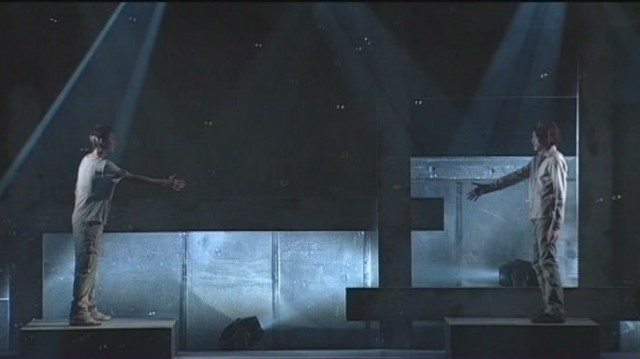
Above: Shiro (Dori, left) and Kuro (Takuya, right) reach out to each other
REVIEW
I'll preface this review by stating that there is very little of Black & White that I did not enjoy. Everything about it from its first watch was amazing, and when I watch it all again, it's like I'm seeing it new for the first time.
CAST:
Kuro - Uehara Takuya
Shiro - Sakurada Dori
Ensemble - Angels, Demons, Other Beings, etc.
Casting & Individual Performances:
The infamous duo of Takuya and Dori. Having done so many AMUSE projects together, it was no surprise to see the pair in yet another amazing stage work. The chemistry and relationship that Takuya and Dori have is incredible, and no matter the project they always put on a great show. Black & White was different however, instead of just a great show Takuya and Dori stared in what I would call a true masterpiece. Uehara Takuya's performance as Kuro the Black Angel was nothing short of stunning and incredible. From his amazing dancing, to his stunts, interaction with Dori as well as other characters and his ability to evoke so many emotions makes him a force to be reckoned with. I cannot imagine anyone else playing Kuro other than Takuya. Then there's Sakurada Dori as Shiro the White Angel. Like Takuya, Dori's performance was remarkable though his character is more lighthearted than Takuya's. Dori's ability to play off of Takuya while attempting to answer the ultimate question of the work makes Black & White more interesting and intriguing by the minute. Takuya and Dori are truly a match made in heaven, and are what brought Black & White alive.
Costumes, Set, Music & Choreography:
Everything about Black & White was incredibly detailed. The Angels live white lives, thus all angels were dressed in flowing white garments, while the demons live black lives and dress in stiff and intimidating black clothes. The set was basic, the main stage with a variety of raised levels along the back wall allowing the actors to make use of the entire stage. The music, though brief, added so much to the story and theme of the play and I've found that many of its tracks will get stuck in my head. But perhaps the most beautiful, inspiring and effective thing of Black & White was its choreography.
Black & White Opening Dance of the Angels and Demons
After watching this opening sequence for the first time, I was stunned. It follows the regular patterns of the groups - the angels move with fluid motion and create beautiful arcs with their bodies, while the demons move more intensely and do various stunts to strike fear into the hearts of their pray. I also loved that for this opening dance sequence, the white demon Shiro danced with the white angels and the black angel Kuro danced with the black demons. Showing that though they seem to have been born in the opposite worlds, their true nature and purpose lies with those of the same color. It is one of the few opportunities where we see Kuro and Shiro with the groups they truly belong in. Concepts like these brought Black & White to a whole new level and brought new energy to the dance itself. Between the angels beautiful movements and the stunts done by the demons, I can easily say that this opening dance sequence is one of the best I have ever seen.
Final Thoughts:
Black & White is simply a masterpiece. It may seem odd at times, but if you can look past its oddities it shows something truly remarkable. Out of everything thus far I have reviewed, I would suggest watching Black & White above all.
Above (left to right): Yoshizawa Ryo as Nagi, Sakurada Dori as Micchan, Uehara Takuys as Doji, Hirama Soichi as Tsuna and Terada Takuya as Tobi
I came across Sign after finishing Black Pearl and looking for other Uehara Takuya projects. It was only by accident that I found the series online and decided to give it a try. Suffice to say, Sign was to be my first ever J-drama series and I wasn't sure at the beginning if I would like it. I had previously heard from a friend that J-drama tended to be too overly dramatic and sometimes could be downright stupid, but thinking of Takuya, I decided to take that chance.
Unlike my previous reviews I will not be posting a "play-by-play" synopsis, mainly because Sign is only a nine episode series. It would take far to long for me to explain the plot from episode to episode, so if from the short synopsis below you find yourself interested, go and watch this short but powerful series.
Synopsis:
Above: Uehara Takuya (Doji)
Doji Oon appears to be an average high school kid, except that he is deaf. After losing his hearing to illness, Doji feels isolated from the world and constantly tries to run from his problems. When he one day visits his older brother Shinji's bar, he watches a group of guys take the stage and begin a dance show. Though deaf, Doji is able to feel the music through the vibrations in the floor and soon after takes up an interest in dancing. His handicap has always been a barrier, but through dance, will Doji be able to overcome everything and everyone that stands against him, and to do this, what will be the ultimate cost?
Like Black Pearl, Sign was produced and starred the same set of actors belonging to AMUSE. Filled with many familiar faces and some new, Sign proved itself to be a deep series despite its short run with a top notch cast.
The main star is none other than Uehara Takuya. Takuya's approach to Doji was very unique and it was obvious that he put a lot of effort into the research of the hearing impaired, as was evident in his speech and actions. I always find shows or plays that focus on disabilities such as this to be especially difficult, as it is easy to rub others the wrong way. Takuya however proved this to be untrue as he made Doji both a sympathetic and highly relatable character. Alongside Takuya was Takahiko, who played Takuya's older brother Shinji. The quote unquote "voice of wisdom" of the series Shinji was a great opposite to Doji, often balancing him out emotionally and having some of the hardest scenes to watch throughout the series. After seeing Takahiko in Black Pearl I was anxious to see him in a more series role and if he would be able to distinguish himself from his true strength in physical comedy. Suffice to say, I was thrilled by his overall performance. Supporting but not forgotten are the other members of the dance group, Micchan, Yuuli and Ibaraki. Each presented their own challenges which the respective actors met and ran with, but the performance of Dori as Micchan especially stood out. The most reserved character of the series and my first encounter with Sakurada Dori, I at first was turned off by the character and didn't want anything to do with him but as the series continued I grew to love and respect him. Without giving to much away, Micchan would become my second favorite character next to Doji. The cast overall gave great performances that were both entertaining and emotional, all while showing both the easy and difficult sides of life.
Other Thoughts:
Though it may not look it from the start, Sign centers completely around dance and music. Both art forms are very close to my heart as dancing was a huge part of my life for many years and I continue studying to be a professional performer. The ultimate message Sign sends is simple: you can do anything, no matter the obstacle. For Doji, the main obstacle is his deafness while other characters struggle with tough family situations, broken relationships, illness and even death. Through it all Sign shows that nothing should stand in the way of your dreams and no matter what anyone else says, you should pursue them.
Final Thoughts:
While points throughout the show were a little too over dramatic for my taste, this nine episode series was quite enjoyable and one I'm glad I stumbled on it. Between its message, its cast (TAKUYA!) and its extremely catchy theme song, Sign is a great series for any Amuse or J-drama fan.
The entire series of Sign can be found on YouTube at:
https://www.youtube.com/watch?v=SpQGrJPuEoU&list=PLzolcttNA5TkzQgd-c-greXn_l5Gl_K3d